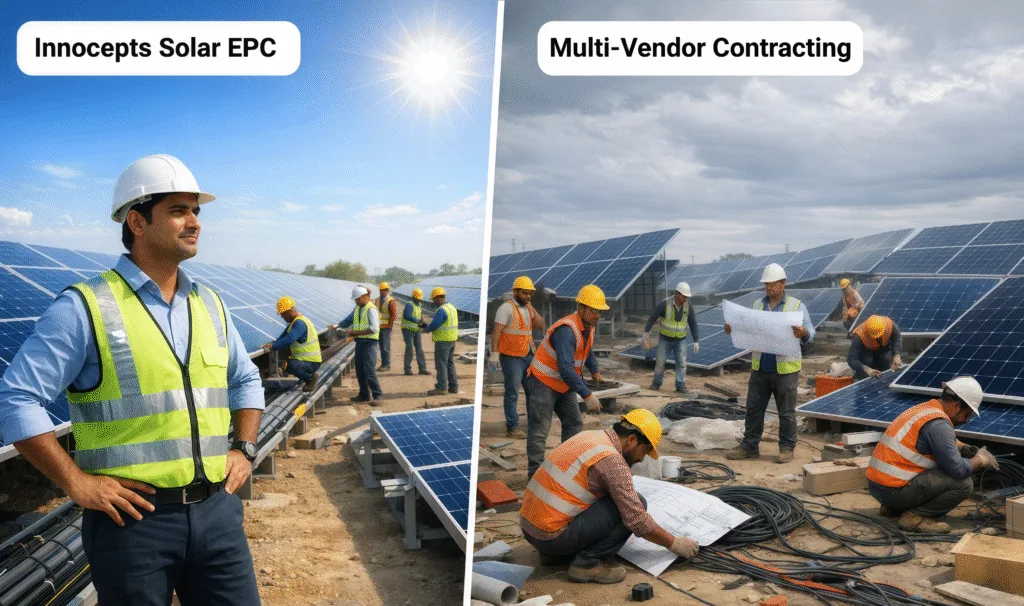
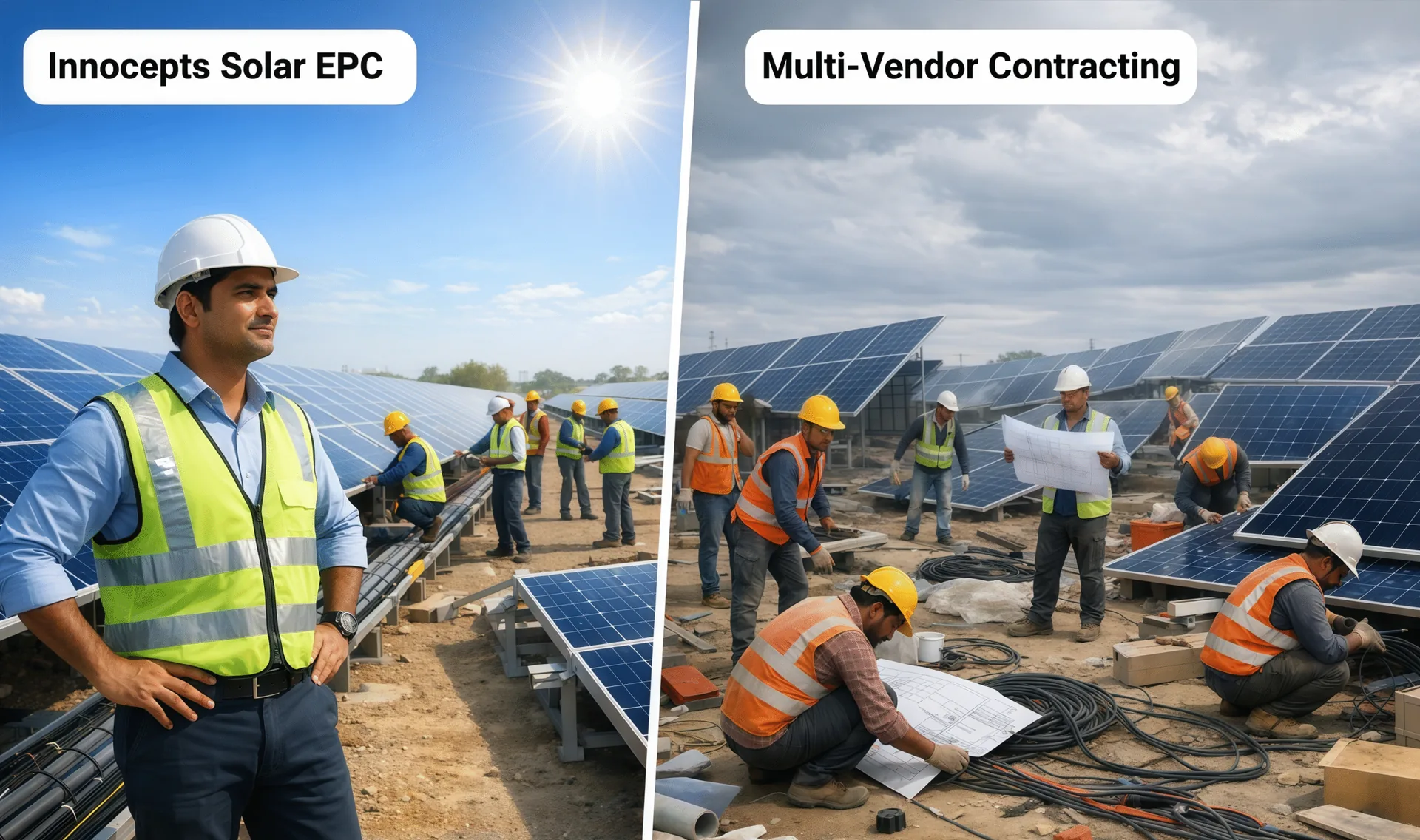
For commercial, industrial, and utility-scale solar buyers, the biggest risk isn’t “Should we go solar?”—it’s how the project will be delivered.
Solar projects have many moving parts: engineering design, procurement of bankable equipment, civil works, electrical integration, grid approvals, commissioning, and handover documentation. As solar PV deployment scales globally, project owners are under more pressure to deliver predictable timelines and dependable output.
In practice, most customers choose between two delivery models:
Solar EPC (turnkey) — one partner responsible for end-to-end delivery.
Multi-vendor contracting — separate contractors for design, procurement, civil, electrical, and commissioning.
Solar EPC (turnkey) — one partner responsible for end-to-end delivery.
Multi-vendor contracting — separate contractors for design, procurement, civil, electrical, and commissioning.
This blog breaks down which model is more likely to deliver on-time commissioning and on-performance generation, and why many serious buyers prefer solar EPC services for risk reduction and ROI protection.
Solar EPC stands for Engineering, Procurement, and Construction—a turnkey model where a single provider manages the full project lifecycle, from design to commissioning.
In a strong EPC structure, the EPC partner typically owns (or tightly controls):
-
Engineering: site survey, layout, system sizing, SLDs, GA drawings, structural design, protection philosophy
-
Procurement: module/inverter/BOS sourcing, logistics planning, QA checks, documentation
-
Construction: civil and electrical execution, EHS supervision, quality control, progress tracking
-
Commissioning & handover: testing, compliance documentation, as-builts, training, and readiness for operations
Engineering: site survey, layout, system sizing, SLDs, GA drawings, structural design, protection philosophy
Procurement: module/inverter/BOS sourcing, logistics planning, QA checks, documentation
Construction: civil and electrical execution, EHS supervision, quality control, progress tracking
Commissioning & handover: testing, compliance documentation, as-builts, training, and readiness for operations
For customers, the EPC model is simple: one contract, one schedule, one accountable owner of outcomes.
If you’re evaluating a turnkey approach, explore Innocepts Solar Private Limited’s Solar EPC Solutions page to see what end-to-end execution typically covers.
In a multi-vendor model, the project owner hires and coordinates separate parties, for example:
a designer/consultant (or internal engineering team)
module supplier + inverter supplier
civil contractor
electrical contractor
SCADA/monitoring vendor
commissioning/testing agency
sometimes a separate O&M vendor
a designer/consultant (or internal engineering team)
module supplier + inverter supplier
civil contractor
electrical contractor
SCADA/monitoring vendor
commissioning/testing agency
sometimes a separate O&M vendor
This approach can be effective when the project owner has a well-established internal project management team or is supported by a strong project management consultant (PMC) who can actively coordinate all stakeholders, manage interfaces between vendors, and maintain strict control over timelines, quality, and costs. However, for most commercial & industrial (C&I) and utility-scale developers, the multi-vendor model introduces a fundamental core challenge: fragmented responsibility, where no single party is fully accountable for end-to-end project execution, increasing the risk of delays, cost overruns, performance shortfalls, and coordination failures.
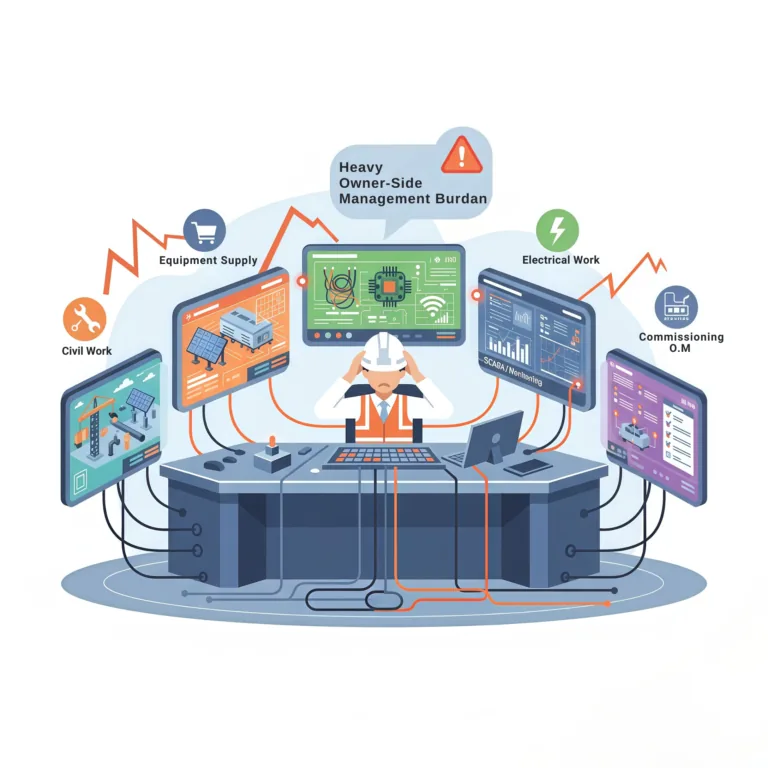
the owner becomes the EPC integrator—without EPC control over people, timelines, and interfaces.
Accountability: who owns the outcome?
-
Solar EPC services create a “single throat to choke.” If something fails—design, supply, installation, testing—the EPC is accountable.
-
In multi-vendor contracting, issues often fall into grey zones (design says supply issue; supplier says installation issue; installer says design issue).
Solar EPC services create a “single throat to choke.” If something fails—design, supply, installation, testing—the EPC is accountable.
In multi-vendor contracting, issues often fall into grey zones (design says supply issue; supplier says installation issue; installer says design issue).
This accountability gap becomes expensive when defects or delays show up late—because fixes happen under pressure and usually cost more.
Timelines: who controls the critical path?
Solar projects slip due to interface delays: drawings not aligned with actual equipment, late approvals, long-lead items arriving after civil readiness, rework during installation, or testing failures at the end.
A strong EPC runs one integrated master plan and aligns procurement + construction to the critical path. Multi-vendor delivery often struggles to maintain one “truth” for schedule because each contractor optimizes for their own scope.
Cost: visible cost vs total delivered cost
Multi-vendor bids can look cheaper on paper. But total delivered cost can rise due to:
-
scope gaps and repeated mobilization
-
change orders and mismatch between design vs actual BOM
-
delays (and the business cost of delayed savings / delayed revenue)
-
warranty disputes and post-handover fixes
scope gaps and repeated mobilization
change orders and mismatch between design vs actual BOM
delays (and the business cost of delayed savings / delayed revenue)
warranty disputes and post-handover fixes
EPC pricing usually includes integration and project governance—often reducing lifecycle “surprise costs.”
Performance: why execution model affects generation
On-paper design is not the same as real-world output. Performance risk increases when:
-
design intent is not buildable (or isn’t built exactly as designed)
-
equipment selection is inconsistent with site conditions
-
workmanship quality varies across contractors
-
commissioning is rushed at the end
-
handover documentation is incomplete
design intent is not buildable (or isn’t built exactly as designed)
equipment selection is inconsistent with site conditions
workmanship quality varies across contractors
commissioning is rushed at the end
handover documentation is incomplete
Standards like IEC 62446-1 define the documentation and commissioning expectations for grid-connected PV systems, reinforcing why structured handover and verification matter.
Compliance: grid connectivity and technical standards
Grid compliance isn’t optional—especially for larger plants. India’s grid connectivity framework includes technical standards and procedures that must be met, making coordinated design-to-commissioning execution essential.
Comparison Table: Solar EPC vs Multi-Vendor Contracting
One integrated master schedule; EPC drives critical path
Interface gaps: “No one owned the integration between civil + electrical + equipment.”
Delayed decisions: more stakeholders = slower resolution cycles.
Rework: design assumptions break during execution, triggering rework and extra cost.
Procurement surprises: substitutions, late deliveries, incomplete documentation.
Warranty disputes: multiple vendors push responsibility elsewhere.
End-loaded testing: issues discovered late, when deadlines are tight.
Performance ambiguity: when output is below expectation, root cause analysis becomes political.
Interface gaps: “No one owned the integration between civil + electrical + equipment.”
Delayed decisions: more stakeholders = slower resolution cycles.
Rework: design assumptions break during execution, triggering rework and extra cost.
Procurement surprises: substitutions, late deliveries, incomplete documentation.
Warranty disputes: multiple vendors push responsibility elsewhere.
End-loaded testing: issues discovered late, when deadlines are tight.
Performance ambiguity: when output is below expectation, root cause analysis becomes political.
These aren’t theoretical risks—they’re the most common reasons owners experience delays, overruns, and underperformance.
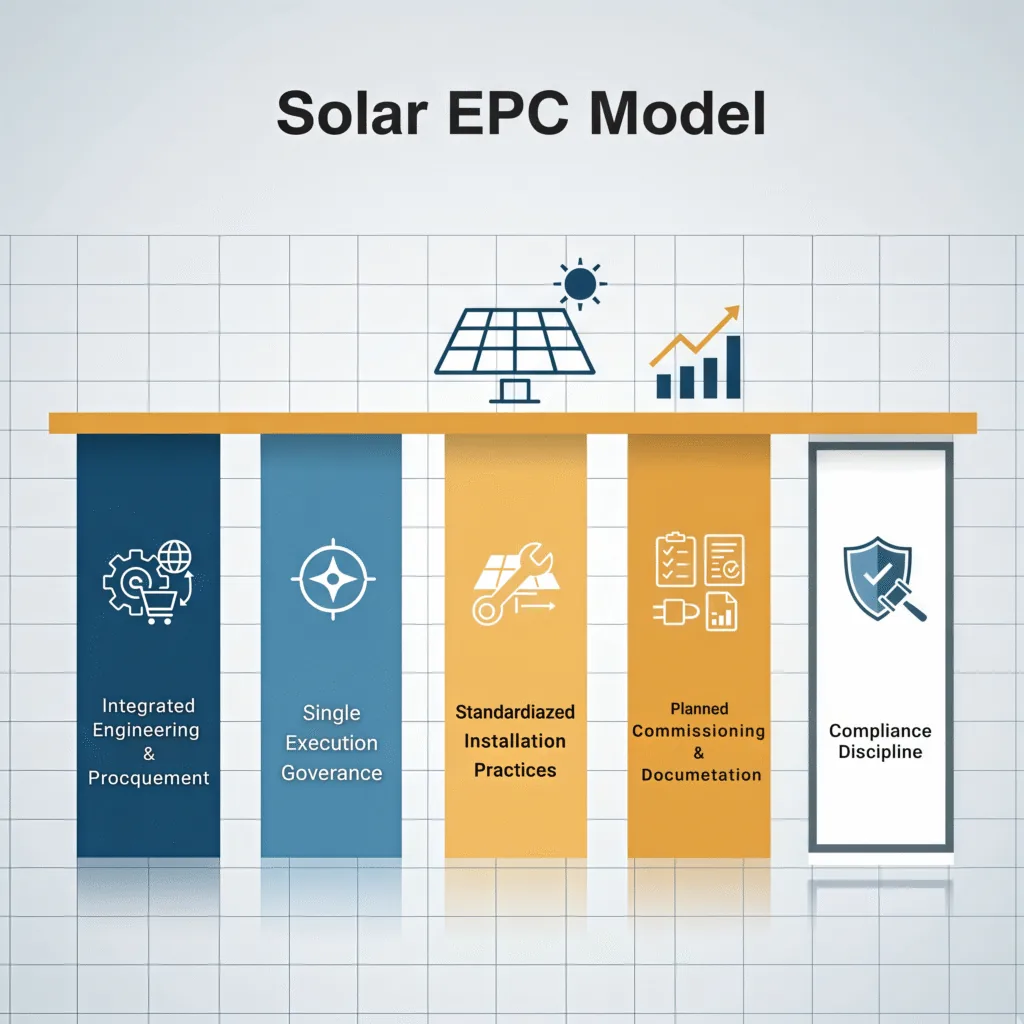
A well-structured EPC model reduces risk because it’s designed to control the variables that actually decide project success:
Integrated engineering + procurement: design is matched to available, verified components (and their datasheets, tolerances, and warranty terms).
Single execution governance: one schedule, one reporting rhythm, one escalation path.
Standardized installation practices: fewer workmanship inconsistencies, fewer latent defects.
Planned commissioning and documentation: EPC teams can align testing, inspection, and handover documentation to accepted standards (e.g., IEC documentation and commissioning expectations).
Compliance discipline: connectivity and grid requirements are managed proactively (not at the last minute).
Integrated engineering + procurement: design is matched to available, verified components (and their datasheets, tolerances, and warranty terms).
Single execution governance: one schedule, one reporting rhythm, one escalation path.
Standardized installation practices: fewer workmanship inconsistencies, fewer latent defects.
Planned commissioning and documentation: EPC teams can align testing, inspection, and handover documentation to accepted standards (e.g., IEC documentation and commissioning expectations).
Compliance discipline: connectivity and grid requirements are managed proactively (not at the last minute).
For buyers who want evidence-based execution, organizations like National Renewable Energy Laboratory publish best-practice guidance around PV installation and O&M, reinforcing the value of disciplined processes over ad-hoc contracting. (Examples: PV Installation Best Practices Guide, PV O&M Best Practices).
At Innocepts Solar Private Limited, we follow global best practices to ensure quality execution and maximize long-term performance.
Innocepts Solar Private Limited’s EPC approach is built around one principle: execution quality is performance.
According to Innocepts Solar’s stated positioning, the company provides end-to-end turnkey solutions—including complete EPC—covering planning, design, commissioning, and lifecycle guidance.
Here’s how that translates into delivery outcomes for C&I and utility-scale customers:
1) Engineering that’s execution-ready
Innocepts Solar Private Limited focuses on designing systems that can be built safely and correctly—reducing redesign and rework risk during site execution.
Learn more about the company background and scope on the About Us page.
2) Procurement aligned to performance and compliance
EPC success depends on equipment decisions that match the site, grid conditions, and compliance needs. In India, policy and guideline ecosystems (MNRE) influence how projects are structured and executed—especially for grid-connected solar. Helpful references include:
MNRE — Solar Policies & Guidelines
MNRE — Grid Connected Rooftop Solar Programme
3) Tight project governance for schedule certainty
On-time commissioning is rarely about one big task—it’s about dozens of small dependencies managed daily. A strong EPC rhythm (look-aheads, issue closure, QA gates) protects timelines.
4) Quality controls that protect long-term output
Long-term performance is driven by installation quality, documentation quality, and commissioning discipline—not just module wattage. IEC guidance on documentation and commissioning expectations illustrates why formal handover practices matter.
5) Utility-scale awareness (tender and grid ecosystem)
For larger projects, understanding the procurement and tender ecosystem matters. SECI’s role as an implementing agency that releases renewable tenders highlights how structured execution and compliance expectations show up in real projects. References:
6) Clear next steps for customers
If you want a delivery model designed for accountability and predictable output, review:
Industrial Solar Solutions (useful context for C&I execution)
Solar Projects (portfolio overview)
Contact Us to discuss timelines, site constraints, and performance expectations
Industrial Solar Solutions (useful context for C&I execution)
Solar Projects (portfolio overview)
Contact Us to discuss timelines, site constraints, and performance expectations
If your priority is on-time commissioning and predictable, on-performance energy generation, solar EPC services are generally the safer and more dependable choice—because the EPC structure is designed around integrated planning, single-point accountability, and disciplined quality control across the entire project lifecycle. This integrated model reduces coordination gaps, limits interface risks, and ensures that design, procurement, construction, and commissioning are all aligned toward a single performance outcome, rather than optimized in isolation.
Choose Solar EPC when:
You have a firm commissioning deadline (utility PPA timelines, open-access milestones, or internal ROI targets)
You want clear ownership of design, construction, warranties, and performance outcomes
Performance risk (PR, availability, yield) has a material impact on your project economics
You prefer a single partner to manage and take responsibility for end-to-end execution
You have a firm commissioning deadline (utility PPA timelines, open-access milestones, or internal ROI targets)
You want clear ownership of design, construction, warranties, and performance outcomes
Performance risk (PR, availability, yield) has a material impact on your project economics
You prefer a single partner to manage and take responsibility for end-to-end execution
Choose Multi-Vendor only when:
You have a strong, experienced internal team or PMC that can function like an EPC integrator
You can actively coordinate multiple vendors, manage interfaces, control QA/QC, and enforce schedules
You have a strong, experienced internal team or PMC that can function like an EPC integrator
You can actively coordinate multiple vendors, manage interfaces, control QA/QC, and enforce schedules
For most C&I and utility buyers, the —cheapest” model on paper is rarely the most economical in reality—the true value lies in the delivery approach that minimizes execution and performance risk, protects long-term performance, and preserves project economics over the full life of the asset.
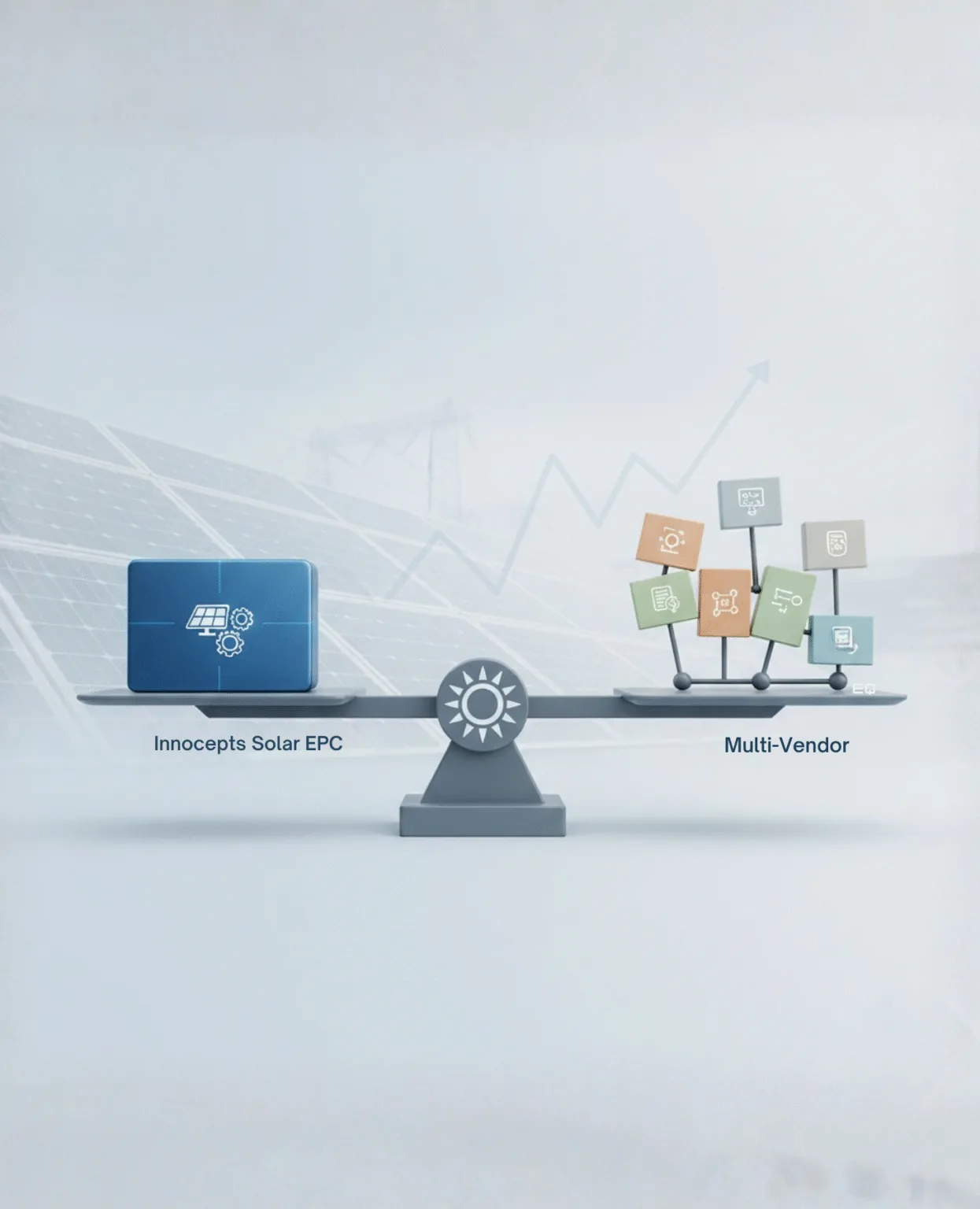
A solar EPC company handles engineering, procurement, construction, and commissioning—delivering a turnkey solar plant with one contract and one accountable party.
The biggest advantage is single-point accountability for schedule, quality, and integrated performance—reducing interface risk across vendors.
In most B2B cases, yes—especially when timeline and output matter. Separate contractors can work, but they require strong owner-side integration capability.
Look for execution capability (project governance), QA/QC discipline, commissioning approach, documentation practices, safety culture, and clarity in warranties and scope.
Delays from coordination gaps, scope omissions, rework, inconsistent quality checks, commissioning failures at the end, and warranty disputes.
Clear scope, equipment specs, delivery milestones, acceptance tests, performance expectations, warranty terms, documentation list, and change-order rules.
EPC aligns design, procurement, and construction under one master schedule—so long-lead items and site readiness match the critical path.
Typical handover includes electrical safety checks, string testing, inverter commissioning checks, monitoring validation, and structured documentation—often aligned with recognized standards like IEC guidance for documentation and commissioning expectations.
In a strong EPC contract, the EPC partner owns the integrated outcome and helps troubleshoot root causes. In multi-vendor models, responsibility is often fragmented.
Some EPC contracts include O&M; others hand over the plant with performance monitoring readiness and then offer O&M as a separate scope.
They’re often used interchangeably. “Turnkey” describes the outcome (ready-to-operate plant), while “EPC” describes the delivery model.
Utility-scale projects typically benefit from EPC because of complexity, compliance requirements, and the cost of schedule slips—making integrated execution critical.